
Choosing the right plc control panel manufacturer can shape an entire automation project. It affects uptime, safety, maintenance, and future expansion. For global buyers, the decision reaches beyond price lists and attractive product photographs. Factory conditions, voltage standards, communication protocols, documentation quality, and local service all matter.
Dick Morley, widely regarded as the father of the programmable logic controller, once said, “The PLC was born out of a need to replace hard-wired relay systems.” His observation still matters today. A modern plc control panel may include a PLC, variable frequency drives, circuit protection, relays, cooling equipment, and human-machine interfaces. Each component must work inside a carefully designed enclosure. Small details matter. Loose labeling creates confusion. Poor heat management shortens equipment life. Inadequate testing can delay production.
This guide examines leading plc control panel manufacturers serving international customers. It considers engineering experience, customization capability, quality systems, factory testing, certifications, delivery performance, and after-sales support. It also looks at practical evidence, such as wiring clarity, inspection records, response times, and successful installations. These factors reveal more than marketing language.
No ranking is perfect. Buyer requirements differ. A food-processing plant may prioritize washdown protection, while a warehouse may need fast integration with conveyor systems. Some manufacturers appear strong on paper but provide limited technical support after shipment. That deserves attention. The best supplier is not always the cheapest or largest. It is the partner that understands your process, communicates clearly, and accepts responsibility when conditions change.
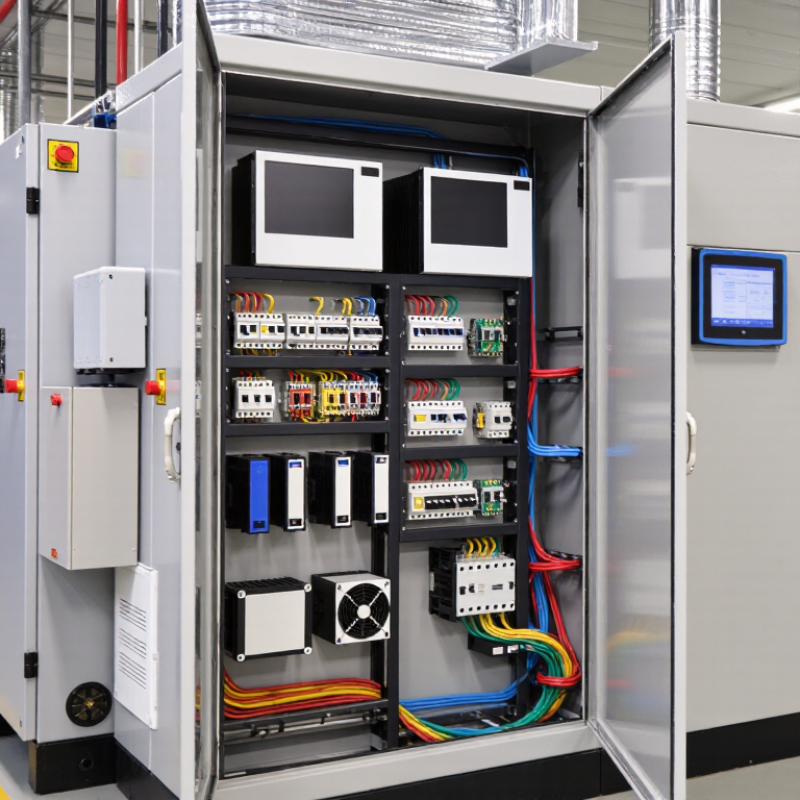
A PLC control panel is an industrial enclosure containing a programmable logic controller, power supplies, relays, circuit protection, and communication equipment. It receives signals from sensors, processes programmed logic, and directs machines through outputs such as motors, valves, and actuators.
This matters.
In a packaging line, a photoelectric sensor may detect a carton within milliseconds. The PLC then checks position, safety conditions, and timing before activating a pneumatic cylinder. Operators view alarms and production values through a human-machine interface. The panel therefore connects field devices, software, and people in one controlled system.
According to the International Federation of Robotics, factories installed 541,302 industrial robots in 2023. That scale increases the need for reliable control architecture and clear machine communication.
For global buyers, panel quality involves more than component selection. Thermal management, wiring discipline, short-circuit protection, network redundancy, and documented testing directly affect uptime. MarketsandMarkets estimates the PLC market will grow from about USD 11 billion in 2023 to roughly USD 14 billion by 2028. However, market growth does not guarantee good engineering. A polished enclosure can still hide poor labeling or difficult maintenance access. In practice, buyers should request electrical drawings, factory acceptance test records, spare-parts guidance, and evidence of compliance with applicable industrial standards. Experienced manufacturers also explain how their panels handle voltage variation, dust, heat, and future expansion. That conversation is often more valuable than a low initial quotation.
Top PLC Control Panel Manufacturers for Global Buyers
Key Criteria for Evaluating Global PLC Control Panel Manufacturers
Selecting a PLC control panel manufacturer requires more than comparing prices. Examine proven project experience, engineering depth, and documented quality procedures. Ask for wiring diagrams, component lists, factory acceptance test records, and references from similar industries. A reliable manufacturer should explain thermal calculations, enclosure ratings, short-circuit protection, and PLC communication methods clearly.
Check whether the panel design matches your destination’s standards and site conditions. Relevant requirements may include IEC 60204-1, UL 508A, local electrical codes, and required IP or NEMA ratings. Confirm voltage, frequency, ambient temperature, altitude, and available maintenance skills before approving the design. Software quality matters too. Request version control, backups, alarm descriptions, and a tested recovery procedure. Small omissions become expensive later.
Tips: Compare sample drawings, not brochures. Review lead times realistically. Confirm spare-part availability and remote support hours. Ask how design changes are recorded. A polished presentation can still hide weak testing. No supplier is perfect; unclear answers deserve a second review. During evaluation, score technical capability, documentation, inspection discipline, communication, and lifecycle support separately. This makes the final decision more objective and easier to defend internally.
This buyer-oriented benchmark uses a 1–5 priority scale. Compliance and safety should be verified against applicable requirements such as IEC 60204-1, while enclosure protection should be matched to the required IEC 60529 IP rating. Buyers should also request documented testing, drawings, component traceability, delivery capability, and after-sales support before final supplier selection.
Leading PLC control panel manufacturers now compete on more than enclosure fabrication. Their market strength often comes from stable engineering, tested components, and responsive commissioning support. MarketsandMarkets’ 2024 PLC Market report estimates growth from about USD 11.2 billion in 2023 to USD 15.2 billion by 2029. This expansion favors suppliers that can standardize designs while adapting voltage, languages, and local compliance requirements.
Manufacturers serving global buyers typically show strength in four areas: sector experience, panel testing, software integration, and after-sales service. IEC 61439 verification, IEC 60204-1 practices, thermal calculations, and documented FAT procedures provide useful evidence. The International Federation of Robotics reported 541,302 industrial robot installations worldwide in 2023. That figure signals sustained demand for dependable control architecture, especially in packaging, logistics, and process plants. Yet certification alone is not enough. A panel may pass inspection and still frustrate operators through poor labeling or weak diagnostics. This is where supplier experience matters.
Tips: Ask for a sample wiring schedule, heat-load calculation, FAT checklist, spare-parts policy, and response-time commitment. Compare lifecycle support, not only purchase price. Request references from projects with similar voltage, PLC platform, and environmental conditions. In practice, the cheapest offer can become expensive after one unclear alarm or delayed replacement. Even experienced buyers should challenge their own specifications; they may describe hardware well but overlook training, cybersecurity, or remote-service boundaries.
| Manufacturer Category | Primary Export Markets | Common Compliance Frameworks | Typical Panel Capabilities | Industries Served | Key Market Strengths |
|---|---|---|---|---|---|
| North American UL-Focused Panel Builders | United States, Canada, Mexico, and projects requiring North American electrical practices | UL 508A NFPA 79 CSA C22.2 | Machine control panels, industrial automation enclosures, motor control panels, disconnect integration, and documented wire labeling | Manufacturing, packaging, material handling, water treatment, and process equipment | Strong familiarity with North American inspection requirements, field installation practices, and customer-specific documentation |
| European IEC-Oriented Control Panel Manufacturers | European Union, United Kingdom, Middle East, Africa, and international EPC projects | IEC 61439 IEC 60204-1 CE UKCA | PLC cabinets, remote I/O panels, machine control systems, safety circuits, and modular automation assemblies | Factory automation, renewable energy, machine building, logistics, and chemical processing | Strong engineering documentation, modular design methods, and compatibility with IEC-based industrial projects |
| East Asian High-Volume Automation Panel Suppliers | Asia-Pacific, Europe, North America, Latin America, and global OEM supply chains | IEC 61439 ISO 9001 CE RoHS | Standard PLC panels, OEM machine panels, compact control boxes, HMI integration, and repeat-production assemblies | Consumer goods, electronics, packaging, automotive suppliers, and general industrial automation | Competitive production costs, scalable manufacturing capacity, and efficient repeat-order management |
| Custom Engineering and Systems-Integration Panel Firms | Global projects involving customized machinery, plant upgrades, and engineered production lines | IEC 60204-1 IEC 61439 ISO 9001 | PLC and SCADA integration, safety PLC systems, variable-frequency drive panels, network architecture, and control retrofits | Automotive, food processing, pharmaceuticals, utilities, and discrete manufacturing | High customization capability, application engineering support, and integration of controls with existing plant equipment |
| Process-Industry Control Panel Specialists | Oil and gas, chemicals, water infrastructure, food processing, and heavy process facilities worldwide | IEC 60204-1 IEC 61439 IP Ratings Hazardous-Area Requirements | PLC marshalling panels, remote I/O cabinets, pump control panels, analyzer panels, and environmental protection solutions | Water and wastewater, chemicals, energy, food and beverage, and bulk materials | Experience with continuous processes, demanding enclosure environments, instrumentation wiring, and operational reliability |
| OEM Machine Control Panel Manufacturers | Global equipment manufacturers, machine exporters, and contract production networks | IEC 60204-1 UL 508A CE | Compact machine panels, operator stations, servo control cabinets, pneumatic interfaces, and prewired skid controls | Packaging, printing, textiles, robotics, machine tools, and assembly equipment | Fast design replication, compact layouts, standardized bills of materials, and integration with machine-builder workflows |
| Energy and Infrastructure Control Panel Suppliers | Power distribution, renewable energy, transportation, utilities, and public infrastructure projects | IEC 61439 IEC 60204-1 IP Protection Local Grid Codes | Motor control centers, pump control panels, solar and battery-system controls, switchboard sections, and remote monitoring panels | Solar power, water infrastructure, district energy, transportation, and utility services | Ability to support large projects, outdoor enclosure requirements, remote monitoring, and infrastructure-focused documentation |
| Low-Volume Prototyping and Rapid-Delivery Panel Shops | Startups, research facilities, system integrators, maintenance departments, and urgent replacement projects | IEC 60204-1 UL 508A CE ISO 9001 | Prototype control boxes, replacement panels, retrofit assemblies, test stands, and small-batch automation cabinets | Research and development, special machinery, laboratories, maintenance, and pilot production | Shorter lead times, flexible engineering changes, rapid prototyping, and practical support for nonstandard requirements |
Top PLC Control Panel Manufacturers for Global Buyers
Manufacturing Standards, Certifications, and Quality Control Practices
Reliable PLC control panel manufacturers treat standards as working tools, not decorative documents. In practice, buyers should check compliance with IEC 61439, IEC 60204-1, and applicable regional requirements. ISO 9001 certification can indicate a controlled quality system, but it does not guarantee every panel is perfect. Ask for current certificates, test reports, and clear scope statements. A certificate without traceable production records deserves careful review.
Quality control should cover the entire build. Technicians should verify enclosure dimensions, terminal labels, wire numbers, torque settings, and component ratings. Functional tests must confirm I/O signals, alarm responses, safety circuits, and communication stability. A practical factory may use inspection checklists, calibrated meters, insulation testing, and documented factory acceptance tests. Photos of wiring before closing the enclosure can reveal routing problems early. Small details matter.
Tips: Request a sample inspection report before placing an order. Confirm how deviations are recorded and corrected. Ask whether engineers review drawings before assembly. Do not rely on visual neatness alone. A clean panel may still contain an incorrect address or loose terminal. Manufacturers should also explain how they manage design changes, replacement parts, and final documentation. I have seen projects delayed by missing wiring schedules, even when the hardware worked. That weakness is easy to overlook. A short video test is useful, but it cannot replace witnessed testing and signed records.
Top PLC Control Panel Manufacturers for Global Buyers
Global buyers should assess a supplier beyond catalog photos and quoted prices. Start with application evidence: PLC compatibility, I/O capacity, motor loads, enclosure rating, ambient temperature, and voltage. Ask for a clear bill of materials and readable electrical schematic. These documents expose hidden substitutions early. Request previous project examples with similar process demands. Practical experience matters. A supplier that explains failure risks earns more trust than one promising perfect performance. No checklist is perfect.
Verify engineering competence through design reviews, wiring standards, component traceability, and factory acceptance testing. The supplier should simulate alarms, interlocks, emergency stops, network loss, and power recovery before shipment. Ask how software backups are stored and how revisions are controlled. Confirm inspection records, insulation tests, labeling quality, and terminal access. Check certifications relevant to the destination market, not merely generic certificates. A panel can pass visual inspection and still frustrate technicians during commissioning. Leave space for maintenance. This is often overlooked.
Commercial reliability deserves equal attention. Compare lead times, warranty terms, spare-part availability, remote support hours, and escalation procedures. Clarify who handles programming changes after site installation. Request a realistic delivery schedule with testing milestones. Very low pricing deserves questions. It may reflect omitted engineering, weak documentation, or cheaper components. I have found that small omissions become expensive delays. Supplier claims need verification, not polite acceptance. Speak with technical references when possible. Technical references often reveal problems that brochures hide.